Showing posts with label Class Notes. Show all posts

Thursday, November 3, 2011

Class Day 11

"Aquaponics" by Nate

Aquaponics is something that is very new, so people are very willing to give information out about this in order to get the word around.  There are very detailed ones, which cost a lot.  And there are some not as high tech, but still works.  We have to start somewhere.  With hydroponics, aeroponics, and aquaponics try not to incorporate any soil into the whole process.

"Horse Farming" by Breana

She wants to get rid of the rubber and plastics in the beddings of the typical barn dwellings for horses.  There are natural materials, but they have to be able to handle the weight and activities of the horses.  She thinks she may be stuck, but it seems just maybe a different line of thinking.  Maybe about how to create better living situations for horses, instead of just making a recyclable bedding that makes them stay in their stall longer.  

So the world population we have reached 7 billion.  In 1804 we hit 1 billion, and over the following 200 years after that we went up 6 billion.  By 2100, we are expected to top out at 10 billion people.  But what will be the deciding factor on that?

For my final presentation need to do the 5 steps to eco-effectiveness provided in Cradle to Cradle Chapter 6.
1. Get "free of" known culprits (p 166)
2. Follow informed personal preferences (p 168)
3. Creating a "passive positive" list (p 173)
4. Activate the positive list (p 177)
5. Reinvent (p 178)

Include also the Material Life Cycle and the Life Cycle Cost portion.

1. Material resourcing availability and location
2. Material harvesting
3. Manufacturing process
4. Material, energy, and transport
5. Material in use
6. Material disposal

Linoleum link: http://www.armstrong.com/commflreu/en-gb/life_cycle_main.html

Book: 1. Presentation and Conclusions 2. Research 3. Class Notes and Reading

Thursday, October 27, 2011

Class Day 10

Need to find any carpet recycling place, carpet sellers, carpet makers, and healthy flooring in KY (500 miles).

Presentations:

"Insulation Materials" by Helda

Looked into UK sponsored insulation projects.  Like at the Johnson Center they have a collection box to gather denim jeans to make insulation.  Cellulose insulation is something she looked into.  She got a sample, and it's made in KY.  The sample was composed of newspapers.  The blue jean denim insulation process seems rather simple, and doesn't contain any hazards.  


"Paint and Pollution" by Mallory


Contacted Sherwin Williams to ask about what is on the market, and their take on the no and low VOC labels.  Did experiments with a variety of paints mixtures, and found a wide range of results.  Would like to maybe try painting on her own walls with the best solution.  


"Healthy Alternatives to Carpet" by me


"Concrete" by Mark


The idea of melting glass bottles down to recycle into concrete isn't a bad alternative, and seems the best way to recycle glass bottles.  This is because companies don't want a mixture of colored glass bottles; they just want their one color for advertising.  He actually went so far as to make his own concrete with glass pieces counter top.  


"Refrigeration Systems" by Jeremy


The refrigeration systems are changing today.  Some companies like Coke have advanced their systems to be somewhat better.  While others are still unhealthy and off gassing continuously.  Want to address question of architects can't use refrigerates and instead what do we need to do.  That's a hard question to answer.  


"Kudzu" by Bridgette


Looking into kudzu in fiberboard.  She did an experiment with kudzu, resin, and a press.  The kudzu that she placed in a pot, actually grew even with resin on.  It's also safe for animals because her dog act some and didn't get sick. 


"SIPS" by Miles


He was very upset with the way the HBEER project is being done.  The idea of construction waste is a major issue being faced.  This can change through education and enforcement.  He went and visited the Toyota supplier, and saw all the waste products there.  

Thursday, October 13, 2011

Class Day 8

We set a game plan for the rest of the semester.
Important dates: Thursday, October 27th, 2011 - Powerpoint Presentation Round 2 and Thursday, December 1st, 2011 - Final Powerpoint Presentation.
Also, we discussed the blog book we have to get printed, and that that should be in pdf form ready to send out to be made before Thanksgiving.

Humans and animals greatly differ when it comes to consumption.  Like for examples ants have a small biomass, and they really leave no waste products behind.  Unlike us...

Materials vary from history because now a days we genetically mutate them to fit our needs.  Which goes against the natural qualities of the material.  

Cities greatly impact the climate.  Industry is a great killer too.  They create new products, and allow products that are hazardous to our health out in the world.  Products need to last, but if they last very long that shuts down jobs for people.  So products are made to expire at a set time, in order to make consumers buy more.  

We are the future.  We need to be educated, and also educate others in the pursue of a happy livable environment. 


Also throughout the class Sarah Heller asked us questions in order to spark questions to continue the conversation going.
* Discuss the role of industry and how humans differ from any other species on the planet with respect to material consumption?
* How does the concentration of population in an urban setting directly impact the adjacent environment?
* How does consumerism is our culture differ from Before and After the Great Depression and World War Era?
* Should we as a society challenge the concept of waste and how?
* In Chapter 3, McDonough describes the "The New Design Assignment" - How does this concept impact the role of the architect?  The role of architecture school?
* How does the research we are conducting in this elective relate to the contemporary role of architecture and interior design?
* What concepts learned in this class will effect your personal philosophy and practice once you graduate with a Master's degree in Architecture?
* Chapter 2 of Cradle to Cradle, William Rathje is quoted as saying "Recycling is an aspirin, alleviating a rather large collective hangover...overconsumption." - Based on the readings and our tour of the recycling facility in Lexington what do we need to do as a culture to confront the concept of overconsumption?
* Why is it important for architects to know how to conduct independent research?


It's through these questions that the conversation continued to go throughout the class period. I was able to give my opinion throughout the class too, which can be seen throughout my thought typed above about the class.

Thursday, October 6, 2011

Class Day 7


University of Kentucky Professor
Biosystems Engineering
Controlled Environment Systems
Donald Colliver, Ph.D., P.E.
* Helped with building of Solar Decathlon House*


dcolliver@uky.edu


The walkways for pedestrians are important around campus.  Have to watch out for rust because it can ruin a pedestrian bridge.  At the University of Kentucky they cover the walkways or heat them to not cause any rust to form.  Rust means death for the pedestrian bridge.  He started by talking about the interaction of environment and buildings.  Buildings are important because they contribute to 9.5% to US GDP through construction and renovation projects.  Buildings energy use is important because they use 70% of US electricity, and 55% of US natural gas.  Buildings are the fastest growing consumer, than transportation and industrial.  They use coal, renewable, natural gas, petroleum, and electricity (which is the main one used, and has increased 53% over the years.  2/5 of CO2 in US is related to buildings.  

Water is a very important thing all over the world.  45% of water usage if by buildings.  Majority of the energy within buildings is used in the HVAC.  The electronics are sucking up electricity.  100 watts of electricity in 30 minutes makes 1/2 lb of CO2 from the coal plant where the electricity in Kentucky comes from.  Lighting is a very complex analysis process, and is a large component in buildings.  Building energy flows can be very complex.


McKinsey Global Institute

Comfort is an important factor for people when it comes to using energy, like with AC...


High performance buildings are helping to reduce energy usage.  Net-Zero energy buildings produce as much energy as they use.  Net-Zero includes: Site Energy, Source Energy, Emissions, and Energy Cost.  Each one has a different meaning when people attach it to a building.


LEED is one of the common branding along with energy saving buildings.  Putting LEED brand on a building is roughly $40 or $50,000!  Energy Star also emerges, and states that they are 30% more energy efficient than regular models.  


ASHEA  -  Advanced Energy Design Guide


It's interesting to see how Engineers think about sustainability compared to Architects.  It's radically different!  Engineers get all technical with various components, while Architects think graphically.  We take a more artist approach to our line of thinking.  Which I feel makes it more relatable to people outside Architecture.

Thursday, September 29, 2011

Class Day 6

Presentations:

"Paint and Pollution" by Mallory

Research.  Explore.  Implement.
Paint composition is pigment and binder.  In the past they used a lot of organic materials, while today we are using additives and synthetic materials to create a longer shelf life.  A typical household paint contains up to 10,000 chemicals.  300 of the chemicals are known toxins and 150 have been linked to cancer.  

"Kudzu" by Bridgette

It's called a "foot-a-night vine" because it grows about a foot a day.  Pros are that Kudzu is edible, renewable, prevents erosion, and soil improvement.  Cons are it grows so fasts that it chokes off other plant species.  


"Carpet" by Me


"Glass" by Mark


The recycling and reuse strategy for glass isn't very much.  Ale 8 is a local company that reuses their glass bottles, and gives a consumer about 25 cents for any they bring in.  The bad part is the closest Ale 8 factory is in Winchester, so it's not really worth the gas to drive out and back to take glass bottles.  Crushed glass is used in counter tops to create interesting effects.  


"Insulation Materials" by Helda


There are many different types of insulation materials.  Fiberglass is a deadly one that has many problems associated with me.  Denim is a healthy alternative.  


"Binders" by Jeremy


He looked at systems and not just materials.  His focus was refrigeration systems, and how to make them safer.


"Horse Barns" by Breana


She looked at different aspects of horse barns.  Bedding is a large one because they go through a lot per week.  Arena footing is something to look into too.


"SIPs" by Miles 


SIPs are Structural Insulated Panels.  The facings used are very strong and very available material.  They are also 100% recyclable, which is a good factor.  Taking at look at the SIPs being used in the HBEER being constructed right now opens up your eyes. 


"Food Production" by Nate


Cuba built a state supported structure to support an urban agriculture.  Aeroponics is the process of growing plants in an air or mist environment.  Hydroponics is a method of growing plants using mineral nutrient solutions, in water, without soil.  

Thursday, September 22, 2011

Class Day 5

Field Trip:
LFUCG Recycling Center
360 Thompson Road
Lexington, KY 40508


When you come up to the main office entrance space to your left is gravel like pieces, but it's glass shards.  They took the glass that they get, which gets broken down through the sorting process (which is what they want to happen) and put it in as gravel like material.  It added a great effect to the whole exterior of the space.  The vibrant color gave it a different appeal.


From there we went up to the classroom to talk about things.  This was the view that we had of the center.  It's a pretty powerful image.


Our tour guides were Esther and an intern.  We were given time to ask questions and for her to discuss certain aspects with us.  The taxes that home owners in the Lexington area pay cover the three cans they are allowed to have.  One is trash, one is recycling, and the last is yard waste.  Just recently they have begun a composting can that is for personal use, and can only be given after the resident has taken a composting class.  This insures that they know what they are doing is right.  The yard waste isn't composted, but it shredded down into mulch that everyone can use.  This center also gets materials in from other Lexington counties outside Fayette.  Also, individual companies that collect recycling bring their materials to this center.  So this center is bringing in a lot of materials.  Recently $3.5 million was spent on new machines that help to make the sorting easier and more accurate.  The center accepts bottles and jugs that are type one or two plastic, and many other material types.  They try to also save on gas by finding local companies that will take the materials they receive once it has been sorted and bundled.  In 2009, the center took in 20,000 tons of materials, and had a revenue of $1.6 million.  In 2010, the center took in 25,000 tons, and made a profit of $2.4 million.  This is much larger than the previous year.  So they are becoming more efficient in what they do.  This is a good sign.  Only 5% of the materials they get in actually gets sent to the landfill because it can't be recycled.  


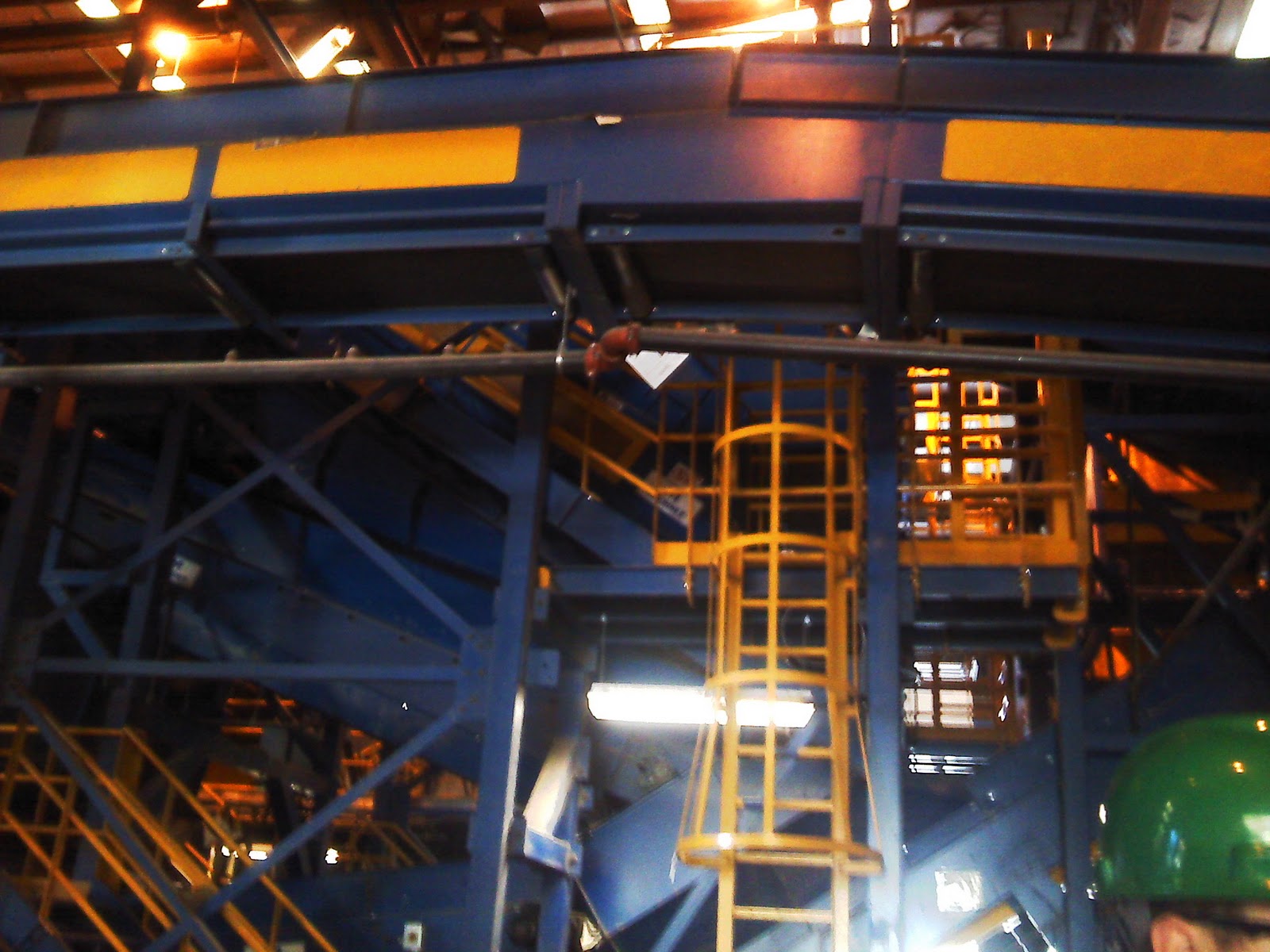
To enter the inter workings of the center you have to wear the proper gear, which includes hard hat, safety goggles, and a vest.  I'm glad it's required because during the tour I was almost hit by a bottle that fell down.  Yet, oddly most of the workers that sort weren't wearing any of this gear.


This is the exterior of the center.  It looks so clean.


Out front they have blue bins that allow people that don't have recycling cans to bring their things in to recycle.  Also there is another bin that metal items can be thrown into, which becomes scrap to another company to use.


I guess that Xbox's are now out of style because we found one laying in the metal scrap pile.


So this hill of material is not even a full days worth of material!!!!


Here is more of a scale to get an idea.  They just kept adding on to it throughout the day.


Sights like this are seen throughout the center.  This could have been someone's dinner.  Here's the left overs...enjoy!


The backside of the mound.  It looks climb-able.


So they take that mound and scoop it into this, which starts the conveyer belt system.


For all you cat lovers...try to reuse your cat litter containers because those can't be recycled.  Instead, they are just stacked under the stairs here until a purpose can be found for them.


Here is the bulldozer scooping the materials into the conveyer belt system.  And so it begins...


The machines in their various colors.


From the start you can view the end result.  This belt has material of the same type throw on to it.  Then the material is dumped into the compresser, and is made into blocks that are tied off.  It's very high tech.  Because different materials require different ties.


Here a magnet separates the metals out from the other things.


Up to be sorted.


People sort out the plastic items from the belt.


The end result is these box like items that can then be shipped out to various companies that will recycle them.

Overall, I greatly enjoyed this trip.  Won't lie though...I did feel very dirty afterwards.  I didn't think recycling could be such a dirty job.  I did learn a lot of things that I didn't know before.  So my knowledge has grown!!!

Thursday, September 15, 2011

Class Day 4


Special Guest: Josh Auroyo
Graduated from University of Kentucky
Architect for HBEER 1 Prototype
Monticello, KY

Talking with Josh before class he told me about the floor system they are using.  The thing they are looking to use is hardwood flooring because it allows for some air flow.  Air flow is needed due to the humidity levels because the building's envelope is sealed rather tight to allow not much energy out.  So humidity can be hidden beneath the floor system; air flow is needed.

The concept behind the HBEER (Houseboat to Energy Efficient Residences) project in general is the idea to create a structure that operates on just $1 a day.  Sadly, this prototype isn't the cheapest to build, ship, and set, which doesn't help.  Site is a huge factor with cost and also with planning.  The project cost $115,000, which was $15,000 over budget, but that doesn't even account for site conditions and land prices.

Calculations play a huge role in the development of this structure.  It's takes time...A variety of programs can also be used to test the best place to set certain aspects.

The materials used have to be researched.  80% to 90% was the goal to have materials from Kentucky.  So the idea of staying rather local is major.  Materials from Kentucky include: Fischer Sips, Castell Woodworking (casework), Monticello Hardwoods (flooring), Pella (impervia windows), and GE (appliances).  Also, certain parts of the prototype have to be brought in from outside Kentucky.

Thursday, September 8, 2011

Class Day 3

 
Special Guest: Barry Prater
847 Angliana Avenue
Lexington, KY 40508
859-225-8100


Central Kentucky Fiber Resources is divided into different divisions, and they are pulp, paper, graphics, packaging, and recycling.  The company was established in 2002, and has 15 employees.  The concept of W-A-L-K is important. W (water) A (and) L (land) K (kritters).  Items can be reduced (use email to save paper), reuse (reuse containers), and recycle.  "Pre"-cycling is the practice of planning for the proper process of preventing pollution by identifying and implementing the best method for returning products and packaging to reusable fiber - prior to purchase.  In 2001, the items in the United States that was thrown away into landfills was 56%, while in Japan it was only 7%.  It was be interesting to see now what the percent would be in Japan, since they got devastated by an earthquake and tsunami.  Recycling consists of categorize, collect, and combine.  Things that are unapproved materials include various grades of mixed paper, contaminated OCC (carbon black), bi-floor (foil and cardboard), and plastics #1-7s (that are not sorted).  Companies that Central Kentucky Fiber Resources include Buffalo Trace Distillery, Goodwill, and Wayne County.  In 2009, Fayette County disposed of 316,558.60 tons of waste.  For a ton that's disposed of, it costs on average $28.34 to do it.   

Thursday, September 1, 2011

Class Day 2

Readings:
Cradle to Cradle by William McDonough and Michael Braungart 
Introduction and Chapter 1 Pages 3-44 
and

The Philosophy of Sustainable Design by Jason F. McLennan 
Handout Pages 1-34

When it comes to industry company/people should show "fair play" and "good will" (p. 6 C to C).  In class we watched a news cast video that talked about "Defective Drywall".  It spoke about how in the southern states that the dry wall put up was bad.  It smelled of rotten eggs and turned all copper pipes black.  How would we even be able to depose of toxic materials when it's reached it's life span?  

REDUCE...RECYCLE...REUSE
HOMEWORK:
Start to look up material and start to question it and then call around.  Also start to perform material experiments.  Maybe call around to get samples.
HOW COULD CARPET BE REUSED AND RECYCLED EASILY?  WHAT OTHER PURPOSES CAN CARPET HOLD?  WHAT CAN PEOPLE DO WITH THEIR OWN CARPET WITHOUT TURNING IT OVER TO SOMEONE ELSE?  OTHER HOUSEHOLD PURPOSES?

First step to research:
Understand what is conventionally being used...
How is the sustainability trend having an effect... 
Ask what, who, when, why...
Call people...

What is biocomposite material?
It is a material formed by mixture of natural fibers.  The resin is replaced by vegetable or animal resin, and the fillers are replaced with natural fibers.  


Second step to research:
Understand how conventional things are made in order to reproduce and experiment...

Third step to research:
Identify a problem and begin to look for solution...

Fourth step to research:
Embark on the journey and find the people who can answer your questions...
Be bold...
Find the experts... 

Looking at the images from Sarah Heller's trip to the recycling center it made me wonder why can't companies just mesh all the colors together to be a genetic item.  Or the fact that companies could make the recycling process a lot easier.  Like with the plastic bottles, they could use the same plastic throughout the bottle and not three different types.  Also, when it comes to labels they get thrown out into landfills, and they could maybe be bio-degradable.